
.png)

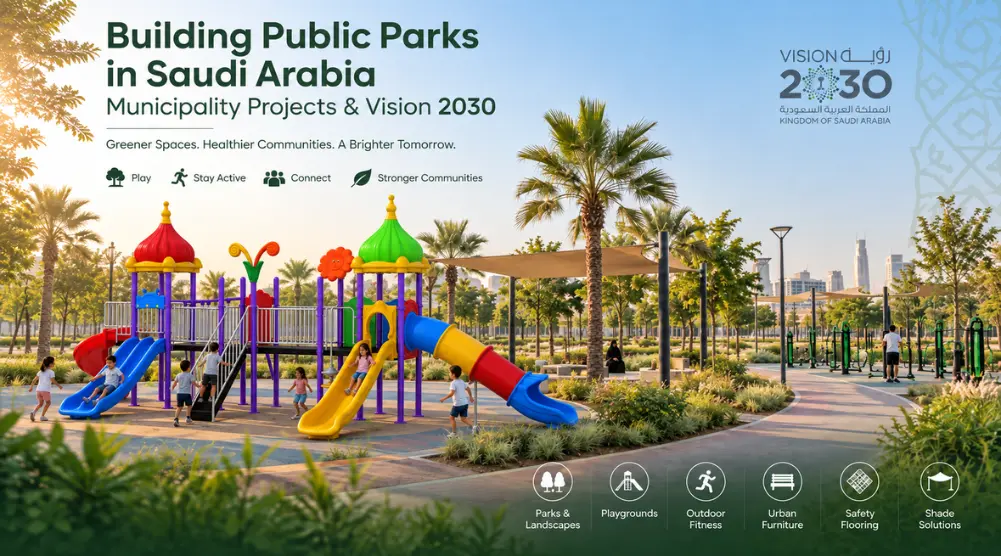

A public park can look perfect on opening day and still stop working within six months.
The playground gets crowded into one corner. The outdoor fitness area sits in full afternoon sun. Benches face the wrong way. A path cuts straight through the middle of the play area. The maintenance team can barely reach half the equipment.
At Garden Links, we rarely see this as a product problem. It is almost always a planning problem.
Good park development in Saudi Arabia takes more than buying playground equipment, trees, benches and lights from separate catalogues. A public park only works when every part of it, the playground, the shade, the paths, the seating and the maintenance access, is planned as one connected space instead of a list of separate purchases.
For a municipality, developer or contractor, the real question is not “what should we install.” It’s how people will actually use the park, day to day, and how every piece supports that.
That question matters more each year, as public spaces across Saudi Arabia get more attention under Vision 2030, and as more cities invest in parks people will actually want to visit and return to.
What Does Public Park Development Actually Include?
Park development starts long before any equipment reaches the site.
A complete public park usually brings together a children’s playground, an outdoor fitness area, walking and jogging paths, shaded seating, planting and irrigation, grass or turf, safety flooring, benches, waste bins, shade structures, lighting, open gathering space and clear access for maintenance.
Finding all of that is not the hard part. Making it work together as one park is.
A playground needs safe space around it for kids to run. Fitness stations need enough room between them. Benches need to face something worth looking at. Trees and shade change how hot a corner of the park feels. Lighting has to help people use the park safely after dark, without spilling light where it isn’t needed.
This is why a municipality park project works best when it’s planned as one connected space, not a set of separate products bought from different suppliers.
Start With People, Not Equipment
The most common mistake in park planning is choosing equipment before anyone has thought through who will actually use the space.
Before picking products, it helps to picture the people who will show up. Young children need low, simple play equipment. Older kids usually want climbing and more movement. Parents need somewhere comfortable to sit where they can still see their children. People who walk or jog benefit from fitness stations placed along their route. Older visitors need benches spaced at reasonable intervals. Maintenance staff need to reach equipment without shutting the whole park down to do it.
This is the whole idea behind intentional playground design: every piece of equipment is there for a reason, not just because there was space for it.
The same thinking should apply to the entire park, not only the playground. Instead of asking how many things can fit on the land, ask what the community actually needs to do there.
Divide the Park Into Clear Activity Zones
A public park becomes much easier to use once its activities are grouped into clear zones.
A typical layout has a children’s play zone, a fitness zone, a quiet seating area, a walking route and some open green space.
These zones don’t need walls between them, but the way people move through them shouldn’t clash. A footpath shouldn’t run through the landing area of a slide. A bench shouldn’t sit where it blocks the fitness area. A toddler zone shouldn’t share its space with equipment built for older kids.
This kind of zoning matters even more on a larger municipality project, where different contractors are often responsible for different parts of the park. A clear site plan keeps everyone building toward the same finished result instead of working around each other.
Plan the Public Playground Around Real Use
A public playground gets used very differently than a small playground in a private garden.
More children use it at the same time. The equipment takes heavier daily wear. Different age groups often arrive together. Parents need to see the whole play area from wherever they’re sitting. All of that shapes what equipment actually belongs there.
A public playground usually combines multi-activity play structures, slides, swings, climbing equipment, balance elements, spring riders, seesaws and separate, gentler activities for younger children.
Bigger isn’t always better here. Spreading a few different play experiences across the site usually works better than cramming everything into one large structure.
If you’re comparing suppliers for a project like this, our guide to choosing a playground equipment supplier in Saudi Arabia covers what to check beyond the catalogue, including materials, installation and after-sales support.
Think About How People Move Between Activities
One thing that’s easy to miss on a drawing is how people actually move once the park fills up.
Kids don’t walk in straight lines. They run from the swing to the slide. Parents cross between the seating and the entrance. Someone on a fitness machine steps back without checking behind them first. A maintenance worker needs to reach equipment carrying tools and parts.
This means circulation has to be planned around each activity, not just between the main zones. It’s worth walking through the entrances, the space around each slide and swing, the walking paths, the seating, the fitness area, and the routes maintenance staff will actually use.
A park with good circulation feels bigger and easier to use, even when the actual land size hasn’t changed at all.
Shade Should Shape the Layout From Day One
In Saudi Arabia, shade isn’t something you add once everything else is already built. It decides whether people actually use a space or walk past it.
Before finalising the layout, it’s worth tracking how the sun moves across the site and marking the spots where people will spend the most time: the playground, the parent seating, the fitness area, and any rest or gathering spots.
Shade can come from trees, pergolas, tensile structures, or a mix of these, but the timing matters more than the material. Adding shade after the equipment layout is already locked in usually creates problems with foundations, walkways or maintenance access.
Outdoor Fitness Brings Adults Into the Park Too
A park becomes far more useful once it isn’t just for children.
An outdoor fitness area gives teenagers and adults a reason to visit too, and it works well alongside a walking or jogging path. A good mix usually covers cardio, strength, balance and stretching.
More equipment isn’t automatically better. A handful of well-chosen stations usually gets more use than a dozen machines that all do roughly the same thing.
For public and school-focused projects like these, the fitness area should sit alongside the paths, shade and seating around it, not get treated as a separate package added on at the end.
Safety Flooring Should Follow the Equipment, Not the Other Way Around
Playground flooring shouldn’t get picked just because it’s the popular choice on other projects.
The right flooring depends on the equipment layout, where children are likely to fall, site drainage, and how the flooring will be maintained over time.
Rubber tiles and EPDM are the two most common choices in Saudi Arabia, but each project deserves its own decision. Our playground rubber flooring guide compares the practical differences between rubber tiles and EPDM, including maintenance and drainage.
The planning order matters here. Equipment gets chosen first, then the fall zones are mapped, and the flooring design follows from that, never the other way around.
Choose Materials That Suit the Saudi Environment
Saudi park projects deal with strong sun, high heat, dust and heavy daily use. Coastal sites bring their own extra wear on top of that.
Depending on the product, outdoor equipment might use galvanized steel, powder-coated metal, outdoor-grade plastic, stainless steel parts, treated timber, concrete, aluminum, rubber surfacing or artificial grass.
There’s no single material that works for every park. A municipality project in Riyadh often has different needs than a coastal site, and a busy urban park usually needs a tougher maintenance plan than a small neighbourhood one.
Every material choice should be checked against the actual site and how heavily it will be used, not picked from a default list.
Don’t Treat Benches as an Afterthought
Benches often get placed last, once the playground, paths and landscaping are already fixed. That’s exactly why they end up in the wrong spot.
Good seating answers a few simple questions. Who’s going to sit here, and what will they be looking at? How long will they likely stay? Does this spot get shade at the times people actually use the park? Does the bench block anyone’s path?
Near a playground, parent seating should give a clear view without sitting inside the play equipment’s movement area. Along a walking route, benches work best as simple rest points spaced sensibly apart. Near a gathering area, which way the benches face changes how people actually use the space.
A bench looks like a simple piece of furniture, but where you put it changes how comfortable the whole park feels.
Lighting Changes How the Park Works After Dark
Public parks in Saudi Arabia see a lot of evening use, so lighting matters just as much as anything else in the design.
Planners need to think through the main walking routes, the area around the playground, the fitness zone, seating, entrances and the maintenance access.
The goal isn’t simply adding more light poles. Lighting should support whatever is happening in each zone and work with the planting and layout around it, not fight against it.
That’s also why lighting works best when it’s planned early, rather than added as a final, separate job.
Build Maintenance Into the Park From the Start
A park isn’t finished the day construction ends. It moves into a much longer phase of daily use, and that phase should shape decisions from the very beginning.
A few practical questions are worth asking while the park is still being designed. Can staff reach the equipment easily? Can parts be inspected without taking half the structure apart? Are damaged flooring sections easy to repair? Can the irrigation be reached without digging up half the park? Are the bins somewhere they can actually be emptied?
These details rarely show up in a rendering or a presentation, but they decide how much effort the park takes to run for years afterward.
For a baldia or municipality project, a layout that’s easy to inspect and repair holds its value far longer than one that only looks good in the handover photos.
Municipality Projects Need Every Package Working Together
A public park project usually has several teams working on it at the same time.
The landscape team handles planting and irrigation. Other contractors handle civil works, the playground, the fitness equipment, lighting or furniture. Without coordination, problems tend to show up late, often after something has already been built.
A playground footing clashes with a service running underground. A tree ends up blocking a light. A path doesn’t line up with the surface next to it. A shade post lands right inside the fitness area’s walking space.
These problems are far easier to fix on a drawing than after installation. That’s the main reason experienced outdoor leisure park contractors KSA teams check how their work lines up with every other package on site, instead of only focusing on their own scope.
A Practical Sequence for Public Park Development
A workable planning sequence looks something like this. Start by understanding the site and who will use it. Decide on the main activities, then divide the park into zones and plan how people move between them. Choose the main equipment, check its movement and clearance needs, then bring in the shade and seating around it. Settle the flooring, add the landscaping and irrigation, and plan lighting alongside the furniture. Finish with a proper check of maintenance access before the final installation.
The exact order shifts from project to project, but the idea stays the same. Every decision gets made as part of one connected park, not as a stack of separate purchases.
Where a Playground Builder KSA Fits Into a Bigger Project
Looking for a playground builder KSA might sound like a simple procurement task, but the job usually involves far more than just supplying equipment.
On a public project, the playground team often coordinates with landscape consultants, main contractors, civil teams, municipality representatives, architects, lighting contractors, flooring teams and irrigation contractors.
The sooner these teams talk to each other, the fewer changes are needed once installation starts.
Garden Links works across playground equipment, outdoor fitness, flooring and landscape elements for exactly this reason. It lets us look at every recreational element against the whole site, instead of specifying each one on its own. Our completed public park project in Madinah followed the same approach, with the playground, fitness area and landscape planned as one layout rather than three separate deliveries.
What Vision 2030 Actually Means for Park Planning
The most useful way to think about Vision 2030 here isn’t through slogans or statistics. It comes down to a simple idea: a public space should give real, everyday value to the people who use it.
For a park, that means looking past how it photographs. A park worth visiting should give people real reasons to walk, play, exercise, rest, meet other people and spend time outdoors, again and again, not just once for the opening.
Good infrastructure alone doesn’t guarantee that. It comes from activities, comfort, easy access and ongoing maintenance all working together, and that’s really the standard every public park should be measured against.
Recent Municipality and Public Playground Projects
Garden Links has completed public playground and municipality projects across several Saudi cities, each shaped by its own site, climate and community needs.
Recent examples include a baldia-led park and playground installation in Jeddah, an outdoor playground project in Al Khobar, an outdoor playground installation in Dammam, a playground installation in Makkah, a school playground project in Al Kharj, and an indoor playground installation in Riyadh.
Each project reflects the same planning approach covered in this guide: understanding the site and its users first, then building the playground, fitness area, shade, flooring and lighting around that.
Common Mistakes in Public Park Projects
A few problems show up again and again when the different parts of a park get planned separately instead of together.
Choosing Products Before Understanding the Site
Working straight from a catalogue is quicker, but it often ends up with equipment that doesn’t actually suit the space available.
Trying to Fill Every Empty Space
Open space is part of good park design. Not every square metre needs a piece of equipment sitting on it.
Ignoring How Playgrounds and Paths Affect Each Other
Poor circulation creates unnecessary conflicts around the busiest play areas.
Adding Shade Too Late
Shade structures added after the layout is fixed tend to clash with equipment, lighting or services already in the ground.
Repeating the Same Type of Activity
Several near-identical pieces of equipment rarely add up to a better experience for visitors.
Designing Only for Opening Day
Maintenance access and repairs need to work smoothly for years, not just look good in the first week.
How Garden Links Approaches Public Park Projects
At Garden Links, we treat recreational equipment as part of the wider park, not a standalone purchase. Depending on the project, that can mean coordinating the playground, outdoor fitness, flooring, furniture, lighting and landscape all under one plan.
The first step is always understanding the project before recommending products. That means looking at the site dimensions, layout drawings, expected users, required activities, existing landscape, flooring needs, shade needs, installation conditions and budget.
With that information, we can select equipment and supporting elements with real intent, not just from a general list.
You can browse more options through our outdoor slides range when you’re planning slide activities as part of a larger play zone.
The Best Public Parks Are Designed as Systems
The strongest public parks rarely depend on one impressive piece of equipment. They work because dozens of smaller decisions support each other.
The playground sits in the right spot. Parents can see their kids from where they’re sitting. The walking route feels natural instead of forced. The fitness area has enough space around it. Shade falls exactly where people actually stay. Lighting supports evening use instead of just decorating the park. Furniture is placed on purpose. Maintenance staff can reach what they need without closing half the site.
That’s the real goal of good park development in Saudi Arabia: not just a park that looks finished on day one, but a public space that keeps working long after the opening photos are taken.
If you’re planning a municipality park, public playground, community recreation space or outdoor fitness area, contact Garden Links to talk through your site, the activities you need, and the overall project scope.
FAQs
What is included in public park development in Saudi Arabia?
Public park development can include landscaping, children’s playgrounds, outdoor fitness equipment, walking paths, shade, seating, lighting, irrigation, safety flooring and other recreation or furniture elements, depending on the project.
How should a municipality plan a public playground?
Start with the intended users, the available site area and the activities they need. The layout should then account for age groups, circulation, equipment movement, supervision, shade, flooring and maintenance access.
What does a playground builder in KSA provide?
The scope varies by supplier and project. It can include equipment selection, layout support, supply, installation and coordination with flooring or surrounding site works. It’s worth confirming the exact scope before appointment.
How much space does a public playground need?
There’s no fixed figure. It depends on how much equipment is planned, expected visitor numbers, movement zones, circulation, flooring and the layout of the surrounding park.
What should municipalities look for in outdoor leisure park contractors in KSA?
Check their relevant project experience, product specifications, installation scope, proposed layouts, coordination responsibilities, warranty terms, after-sales support and their ability to work alongside other contractors on site.
Why is intentional playground design important?
Intentional playground design ties equipment choices to user age, movement, supervision, circulation and the actual purpose of the space. It stops equipment being added just because there’s room for it.
Can playgrounds and outdoor gyms share the same public park?
Yes. They can form separate but connected zones, as long as circulation, spacing, user groups, shade and the surrounding landscape are considered during planning.
How should public park equipment be chosen for Saudi conditions?
Selection should account for sun exposure, heat, dust, expected usage and, where relevant, coastal conditions. Each product should be reviewed on its own rather than assuming one material suits every location.
