.png)

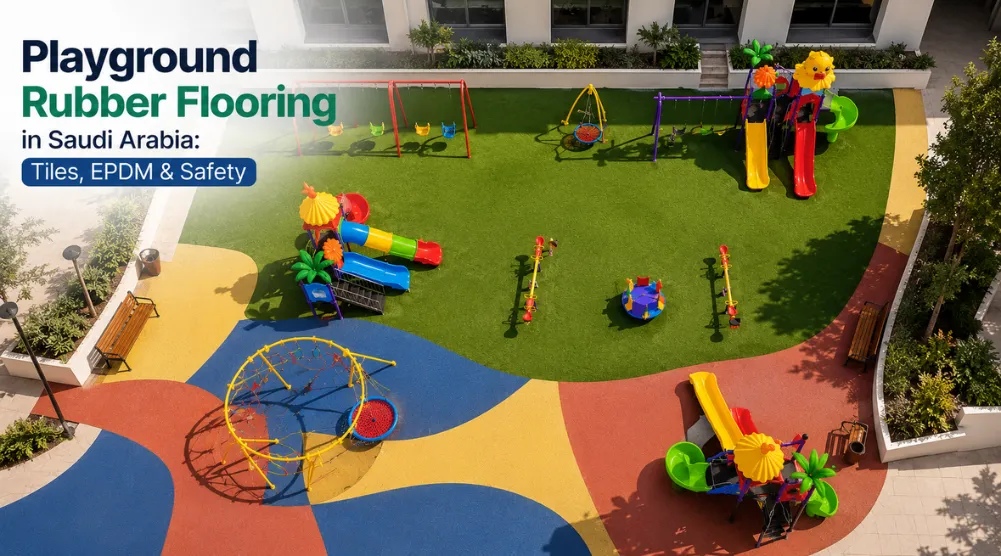

A playground surface may look excellent on handover day, then become uncomfortably hot, develop lifting edges, collect water, or provide unsuitable impact performance for the equipment above it. For teams researching Playground Rubber Flooring Saudi Arabia, these risks show why colour and price cannot guide the decision alone.
Rubber tiles and poured EPDM behave differently under heavy use, direct sunlight, dust, humidity, repeated washing, and poor drainage. The substrate below the flooring, the installation method, and the equipment fall height all influence the final result.
This guide explains how each flooring system works, what critical fall height means, and what you should check before approving a surface for a school, nursery, park, villa, residential compound, or commercial playground.
What Is the Best Playground Rubber Flooring in Saudi Arabia?
The best system is the one that matches the equipment fall height, site conditions, drainage design, expected use, and maintenance plan. Rubber tiles suit modular replacement, while poured EPDM suits seamless and curved layouts. The complete tested construction matters more than colour, material name, or thickness alone.
What Does Playground Rubber Flooring Do?
Playground rubber flooring creates a firm surface beneath and around play equipment. When correctly specified and installed, it can help reduce the impact of a fall. It cannot prevent falls or guarantee that injuries will not happen.
The flooring can also define activity areas, create clearer routes, and provide a practical surface for cleaning. Accessibility still depends on the complete layout, including gradients, transitions, firmness, stability, and the applicable project requirements.
Performance comes from the complete installed construction, not only the visible finish. A system may include:
- A prepared substrate
- An impact-absorbing rubber layer
- A coloured wearing course
- Binder, primer, or adhesive
- Perimeter restraints
- Drainage and edge details
A suitable surface should address impact performance, drainage, access, cleaning, inspection, and repair before decorative colours are selected.
Main Types of Playground Rubber Flooring
Two widely used unitary surfaces are prefabricated rubber tiles and poured-in-place rubber systems with an EPDM wearing course.
“Unitary” means the flooring forms a fixed surface rather than a loose material such as sand or wood fibre.
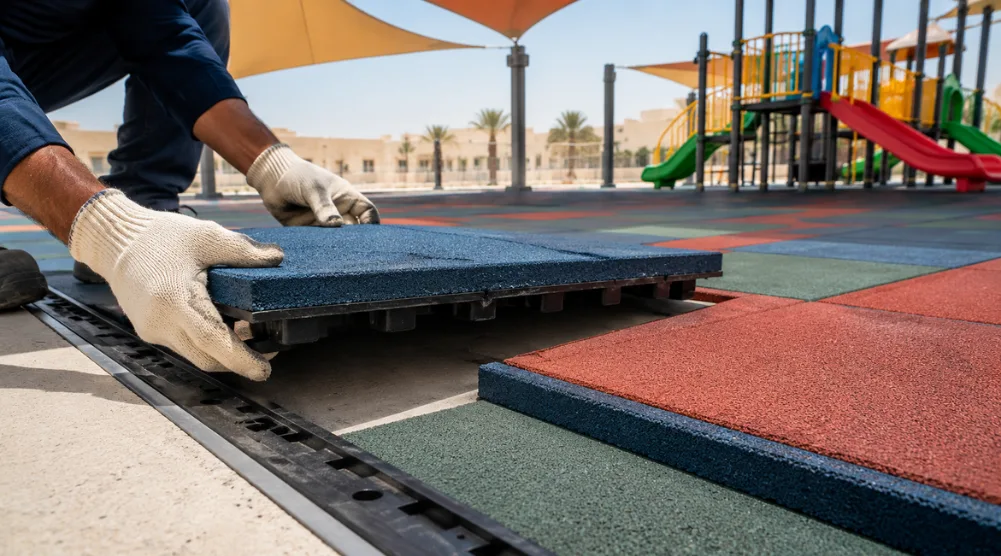
Rubber tiles arrive as factory-made sections. Installers place them over a prepared substrate using the fixing method specified for that product.
Poured systems are mixed and installed at the site. They usually create a continuous surface with fewer visible joints.
Neither type is automatically better. The right choice depends on the layout, impact requirement, substrate, exposure, maintenance resources, and repair strategy. You can review different playground flooring solutions to understand the available surface categories.
Rubber Playground Tiles
How Rubber Tiles Are Made and Installed
Rubber tiles are prefabricated and delivered to the site in individual sections. Depending on the product, they may use recycled rubber, synthetic rubber, pigments, binders, or a combination of materials.
Construction varies between products. Some tiles use a similar rubber composition throughout. Others combine a resilient body with a separate coloured surface.
Do not assume that two tiles of the same depth provide equal impact performance. Ask for technical information covering the exact product, construction, and thickness being proposed.
Installers normally place the tiles over a firm and accurately levelled substrate. The fixing method may involve adhesive, connectors, interlocking edges, perimeter restraint, or several methods together.
Rubber tiles cannot permanently hide movement, poor compaction, cracks, incorrect levels, or drainage defects beneath them.
Benefits of Rubber Tiles
Tiles can be useful where local replacement is a priority. If one section becomes damaged, the maintenance team may be able to remove that tile without disturbing a large surrounding area.
They are often considered for:
- Small and medium playgrounds
- Regular or rectangular layouts
- Villas and residential compounds
- Refurbishment completed in phases
- Projects that value modular repairs
Factory production can provide consistent dimensions. Tiles also require less wet mixing at the site than poured rubber.
Limitations of Rubber Tiles
Every tiled surface contains joints. Those joints require accurate alignment, effective restraint, and regular inspection.
Poorly installed tiles may move, separate, curl, or form raised edges. Dirt can gather in open joints, while incorrect cuts around posts, foundations, drains, and curved borders can leave weak details.
A replacement tile may also appear different from surrounding tiles that have faded or weathered.
Poured EPDM Playground Flooring
How a Poured System Is Built
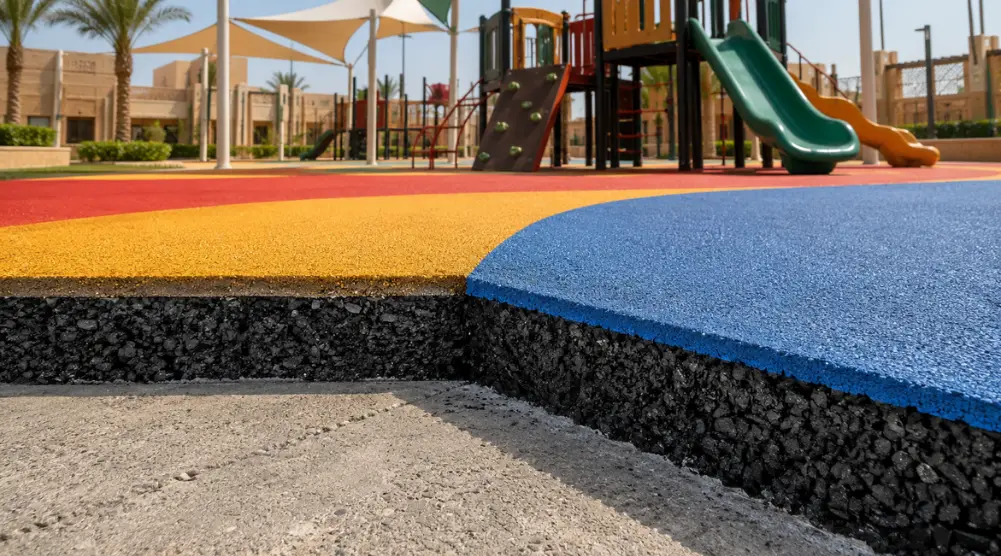
Many poured playground systems use more than one layer, although the exact construction varies.
A typical system may include:
- A prepared substrate approved for the product
- A resilient rubber base layer
- A coloured EPDM wearing course
The lower resilient layer usually provides much of the depth used for impact attenuation. It is commonly formed from rubber granules mixed with a binder.
The EPDM wearing course forms the visible surface. It provides colour and texture while protecting the layer beneath from everyday foot traffic and exposure.
The layers have different functions. A thick-looking coloured finish does not prove that the system provides suitable impact performance.
Some products use different materials, depths, or layer combinations. Review the exact proposed build-up and its supporting test information rather than assuming every poured surface is identical.
Rubber Granules for Playground Flooring: SBR vs EPDM
Rubber granules are used to create impact-absorbing playground flooring for schools, parks, nurseries and residential compounds in Saudi Arabia. In many poured rubber playground flooring systems, two types of granules are used for different purposes.
SBR Rubber Granules: Commonly used in the lower cushioning layer, SBR granules are mixed with a suitable binder to form an impact-absorbing base. The layer thickness and complete system construction are selected according to the required impact performance.
EPDM Rubber Granules: Commonly used in the coloured upper wearing layer, EPDM granules provide the finished surface appearance and are selected for their properties under outdoor exposure and regular use.
For playground rubber flooring in Saudi Arabia, the combination of SBR and EPDM layers, binder quality, substrate preparation and installation workmanship influences the final surface performance.
Before approving any rubber granules flooring system, request technical specifications and impact-test documentation covering the complete proposed construction and the required critical fall height.
Benefits of Poured EPDM
Poured flooring creates a continuous appearance with fewer visible joints. It can follow curves, irregular borders, equipment posts, pathways, simple graphics, and colour zones.
It is often considered for:
- Large school playgrounds
- Public parks
- Nurseries with defined activity zones
- Curved or irregular layouts
- Inclusive circulation routes
- Commercial projects with specific design needs
Good workmanship can create clean detailing around posts, drains, kerbs, foundations, and adjoining surfaces.
Limitations of Poured EPDM
Poured flooring is highly dependent on site preparation and application quality.
Material proportions, binder distribution, layer depth, trowelling, substrate condition, temperature, humidity, and curing conditions can influence the result. Installers should follow the product manufacturer’s written procedures and permitted working limits.
Poor preparation or installation can contribute to:
- Thin or uneven areas
- Loose granules
- Weak perimeter edges
- Cracking
- Surface depressions
- Separation between layers
A visible defect does not always reveal its cause. Movement, trapped moisture, weak adhesion, unsuitable materials, or poor edge support may require investigation before repair.
Poured areas can be patched, but repairs may remain noticeable. New EPDM may not perfectly match older material that has faded or weathered.
Rubber Tiles vs EPDM Playground Flooring
When comparing Playground Rubber Flooring Saudi Arabia options, assess the complete installed system rather than only its appearance.
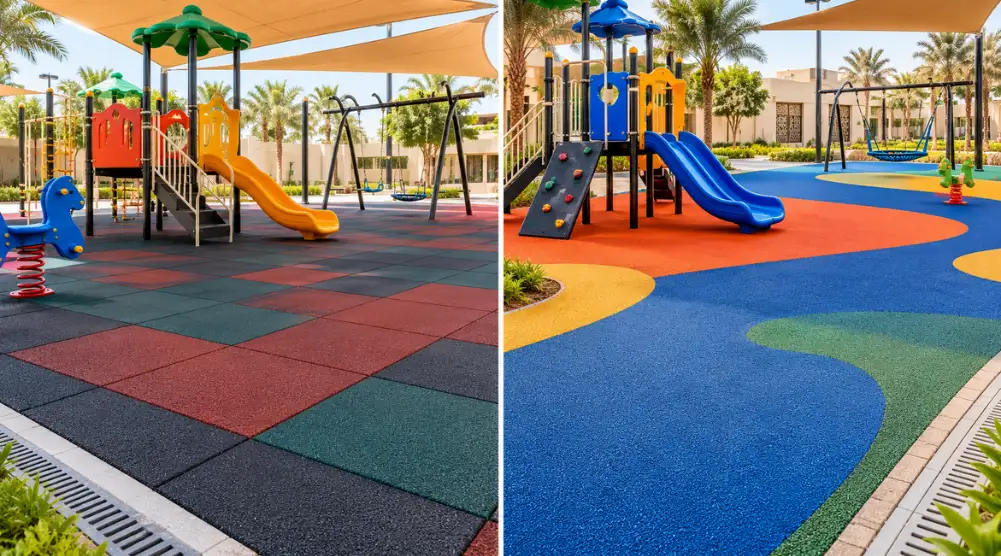
| Decision Factor | Rubber Tiles | Poured Rubber with EPDM Finish |
| Appearance | Modular surface with visible joints | Continuous finish with fewer joints |
| Layout flexibility | Suited to regular areas and modular patterns | Adaptable to curves, graphics, and colour zones |
| Site installation | Factory-made sections installed at the site | Materials mixed and applied at the site |
| Repairs | Individual tiles may be replaceable | Damaged sections can be cut out and patched |
| Repair appearance | New tiles may differ from older ones | Patches may remain visible |
| Joint management | Joints require regular inspection | Fewer joints, although cracks can still develop |
| Base needs | Firm, level, stable, and correctly drained | Firm, level, stable, and correctly drained |
| Main workmanship risks | Alignment, fixing, cuts, and edging | Mixing, binder, depth, trowelling, and curing |
| Often considered for | Regular areas where modular repair matters | Irregular or design-led areas needing a continuous finish |
Flooring planning should be coordinated with the selected outdoor playground equipment. Equipment type, position, and fall height affect the required impact areas and flooring performance.
Playground Rubber Flooring Saudi Arabia: Safety and Critical Fall Height
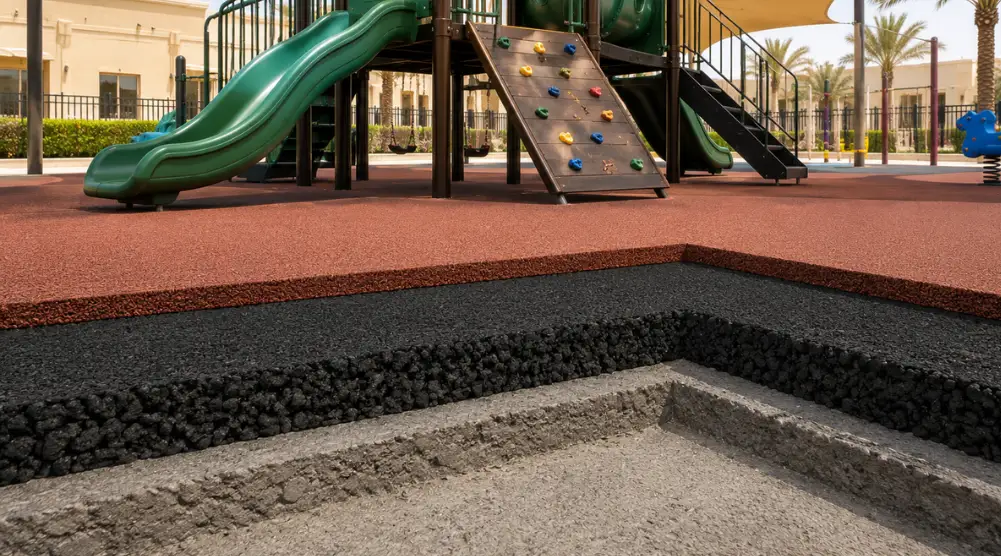
What Is Impact Attenuation?
Impact attenuation describes how a surface reduces impact forces during testing. It is concerned mainly with the effect of a child’s head striking the surface.
A test result does not mean the flooring prevents every injury. It provides a recognised way to evaluate and compare the impact performance of a specific surface construction.
What Is Critical Fall Height?
Critical fall height is the height rating determined through an applicable impact test for a particular surfacing system.
In practical terms, the surface rating should equal or exceed the applicable fall height of the equipment installed above it.
The Gulf standard GSO EN 1177 specifies equipment and test methods for determining the impact attenuation of surfacing through laboratory or on-site testing. ASTM F1292 also expresses playground-surface impact performance as a critical fall height under its test procedures.
A critical-fall-height result applies to the tested system and conditions. Installation quality, ageing, moisture, ultraviolet exposure, contamination, temperature, wear, and loss of depth can affect actual performance over time.
For wider equipment and inspection guidance, read the Garden Links overview of playground safety standards.
Equipment Fall Height and Flooring Performance
Equipment fall height is the vertical distance defined between a relevant elevated component and the protective surface below it.
The correct reference point varies by equipment type. Project teams should use the applicable equipment requirements or manufacturer documentation rather than estimating it visually.
Before approving the flooring, ask for:
- The applicable fall height for each equipment item
- The required impact area around each item
- The complete proposed flooring construction
- The impact-test method used
- The exact materials and depths covered by the report
- Confirmation that the proposed rating meets the project requirement
A generic brochure or test report for a different product does not confirm the performance of the system being quoted.
How Flooring Thickness Relates to Equipment Height
There is no universal playground-rubber thickness.
Impact performance depends on the tested layer construction, including the rubber type, density, granule size, binder, layer depth, and material combination.
Conditions after installation can also affect performance. These include substrate condition, workmanship, temperature, moisture, wear, contamination, and ageing.
Two systems with the same overall depth can perform differently. One may use a denser rubber, a different resilient layer, or another binder formulation.
For this reason, never select thickness from a generic chart alone. Request documentation that identifies:
- The exact surface system
- Each material layer
- Tested layer depths
- The impact-test method
- The resulting critical fall height
- Any stated installation conditions
Field impact testing can assess the installed surface at specific locations and drop heights. However, ASTM F3313 states that its field method does not establish a new critical fall height or certify the surface to ASTM F1292.
Base Preparation and Drainage
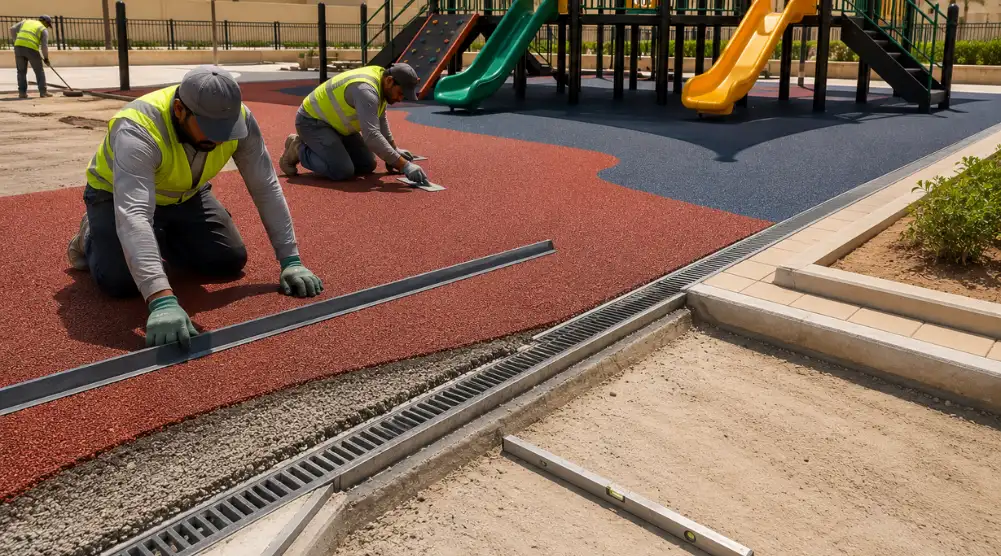
Begin with a Suitable Substrate
Defects in the substrate can contribute to movement, ponding, cracks, unevenness, or surface separation.
Depending on the selected system, the substrate may be concrete, asphalt, or another specifically designed construction. The flooring manufacturer’s instructions and project specification should confirm compatibility.
Before installation, inspect:
- Strength and stability
- Surface levels
- Existing cracks or movement
- Moisture
- Dust, oil, and contamination
- Drain positions
- Required gradients
- Equipment foundations
- Perimeter transitions
The substrate should be clean, stable, and correctly prepared. Loose material, standing water, incompatible coatings, laitance, or curing compounds may interfere with bonding.
Plan Where Water Will Go
A porous rubber surface may allow water to pass through it. That does not create a complete drainage system.
The design should explain whether water:
- Runs across the surface
- Passes through the flooring
- Uses both routes
Base gradients, drains, kerbs, outlets, and surrounding landscaping must support the chosen method.
Poor drainage can lead to ponding, trapped dirt, persistent moisture, or stress around joints and bonded areas. The exact effect depends on the system and substrate.
Drainage matters after cleaning as well as rainfall. Schools, nurseries, compounds, and parks may wash the surface regularly, so water needs a clear exit route.
Finish Edges Carefully
Edges and transitions include cuts, changes in support, adjoining materials, concentrated foot traffic, and cleaning loads.
Give particular attention to:
- Entrances
- Ramps
- Kerbs
- Drains
- Equipment posts
- Doorways
- Changes between rubber and landscaping
Every edge should be supported, securely finished, level, and protected from avoidable construction or vehicle damage.
Weak restraint can contribute to tile movement, open joints, or breakdown of poured rubber at the perimeter.
Heat, Colour, and Shade in Saudi Arabia
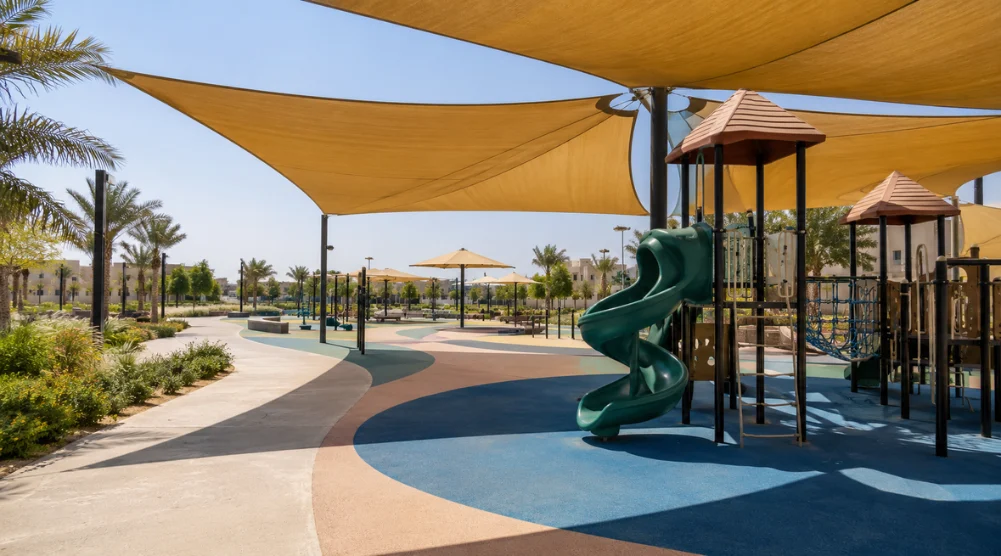
Rubber flooring can become very hot under direct Saudi sunlight.
Its temperature depends on:
- Colour
- Material composition
- Solar exposure
- Air temperature
- Wind
- Shade
- Time of day
Darker versions of similar materials commonly become hotter than lighter versions in direct sun. However, colour alone cannot predict a safe surface temperature.
Project teams may consider lighter colours and shade for exposed, high-contact areas. This is a practical design precaution, not a guarantee that the surface will remain cool.
Shade also moves throughout the day. Check its position over toddler zones, slide exits, waiting areas, access routes, and frequently touched surfaces during the hottest operating hours.
Facility teams should inspect exposed surfaces before use during extreme heat and follow a clear site procedure. A quick touch alone is not a precise temperature measurement.
Installation and Maintenance in Riyadh
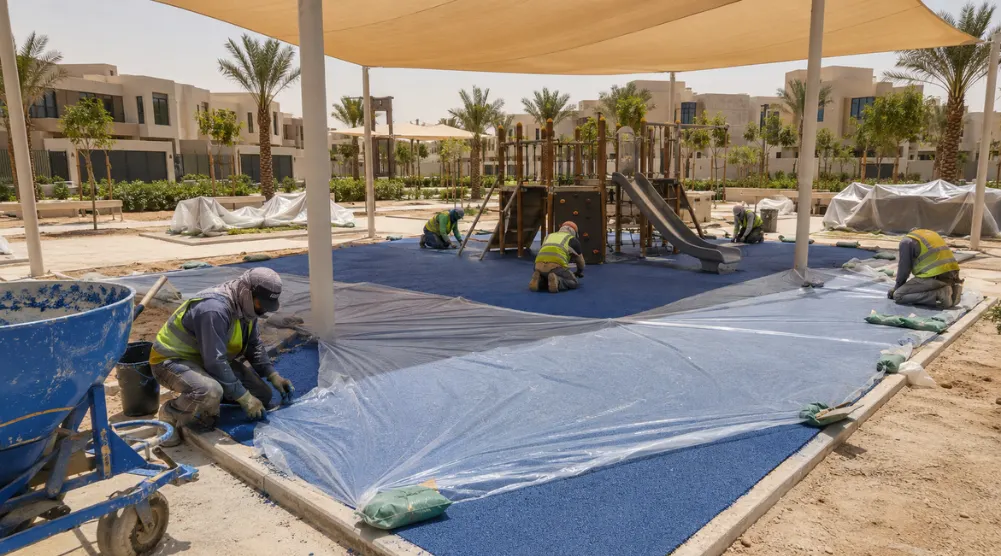
Riyadh brings intense sunlight, high surface temperatures, dry wind, and fine dust.
These conditions may take primers, binders, or adhesives outside their stated application limits. Contractors should measure and record relevant site conditions, including substrate temperature where required.
Dust on the substrate or within uncured flooring may interfere with bonding and surface quality. The work area should be cleaned and protected from nearby excavation, cutting, or landscaping.
Fine dust can also settle in textured surfaces and drainage openings, making regular cleaning important.
Coastal Conditions in Jeddah, Dammam, and Khobar
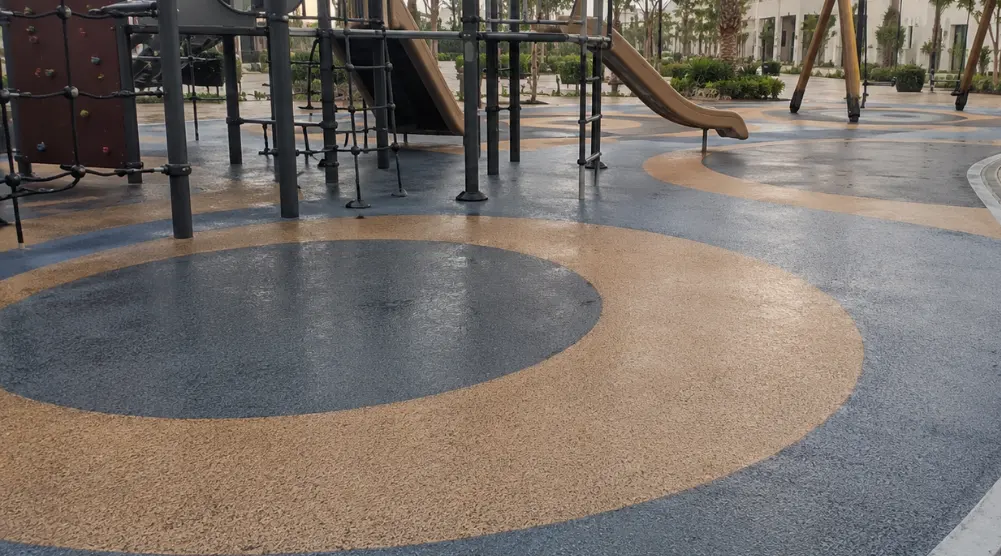
Coastal projects may experience higher humidity, substrate moisture, and airborne salts than inland locations. Exposure varies according to distance from the coast, shelter, drainage, and surrounding activity.
Humidity and substrate moisture should remain within the limits specified for the selected product during application and curing.
Metal edging, anchors, drains, foundations, and nearby equipment should also suit the site’s corrosion exposure. Rubber surfacing should not be treated as corrosion protection for adjacent steelwork.
Where flooring meets structural components, the project team should coordinate those details with the materials used in the wider playground. The Garden Links guide to playground materials provides additional context on common outdoor equipment materials.
Cleaning, Inspection, and Repairs
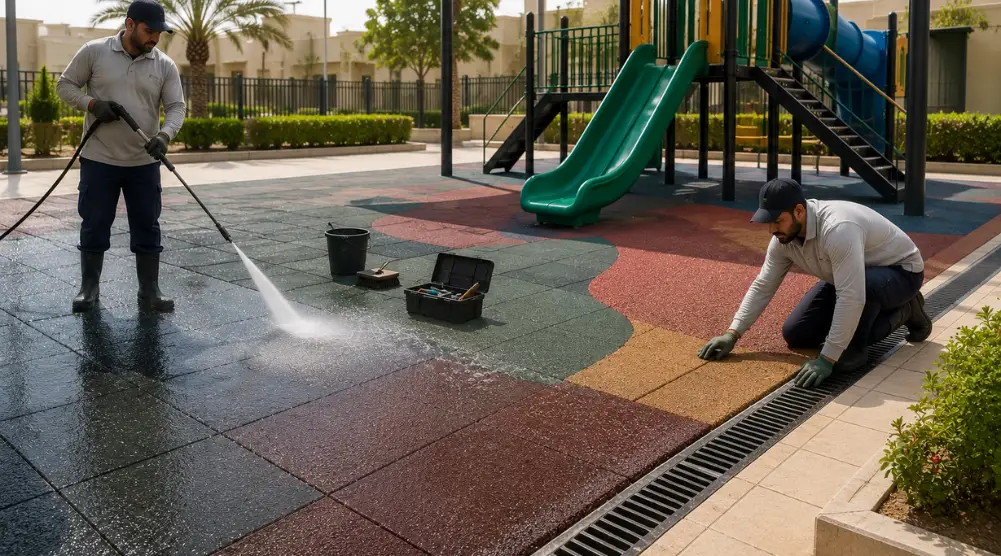
Rubber flooring requires planned cleaning, inspection, and timely repair.
Remove sand, leaves, food waste, and litter regularly. Follow the flooring manufacturer’s instructions for detergents, water pressure, cleaning equipment, and drying.
Inspect for:
- Open tile joints
- Curling or lifting edges
- Cuts and cracks
- Loose granules
- Worn surfaces
- Exposed lower layers
- Depressions
- Ponding water
- Blocked drainage
- Damage around posts and entrances
Give extra attention to swing paths, slide exits, climbing approaches, entrances, edges, and transitions. These areas often receive concentrated traffic or repeated impact.
A raised tile should be assessed before it becomes a larger edge defect. Cuts, loose granules, cracking, or separation in poured rubber also need prompt investigation.
Do not repair only the visible symptom. A patch may fail again if the original cause is trapped moisture, substrate movement, poor adhesion, or weak edge support.
Keep written records of inspections and repairs. Photographs taken from the same points can help facility teams track gradual changes.
Selecting Flooring for Different Projects
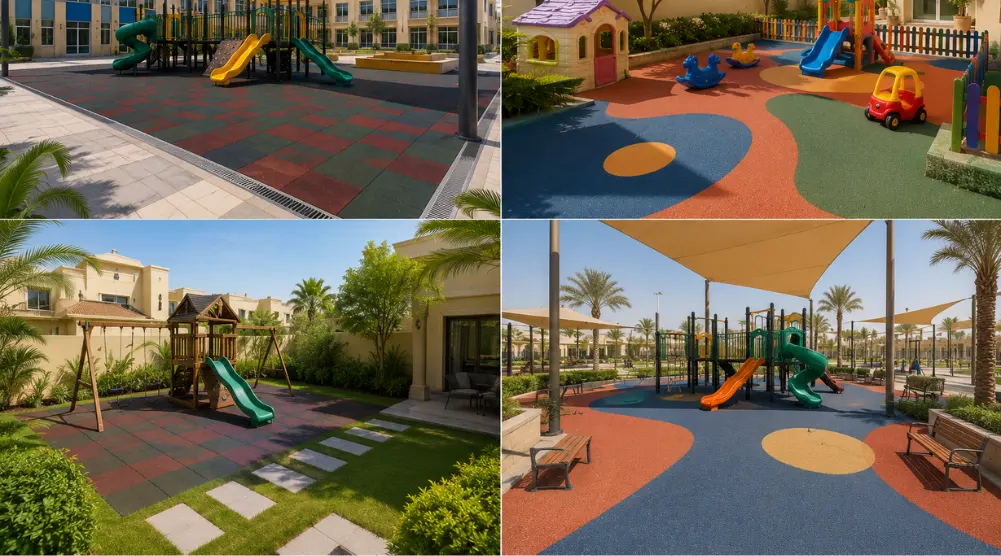
Project type helps define traffic, cleaning, supervision, appearance, and maintenance requirements. It does not replace technical assessment of the equipment and surface.
Schools
School playgrounds normally experience regular daily traffic and repeated cleaning.
Either tiles or poured flooring may be suitable when the proposed construction meets the project’s impact requirements. Schools should also prioritise durable transitions, clear drainage, practical repairs, and documented inspections.
Nurseries
Nurseries need surfaces suited to younger age groups, close-contact activity, frequent cleaning, shade, and smooth transitions.
Simple colour zoning can help staff separate activities. Decorative graphics should not complicate later repairs or obscure surface damage.
Public Parks
Public parks may face high visitor numbers, weather exposure, vandalism, dust, and slower repair response.
The design should make inspection, drainage access, and local repair practical. Maintenance responsibility should be established before handover.
Residential Compounds
Compounds need flooring that works for shared family use and can be managed by the facility team.
Tiles may suit smaller regular areas, while poured flooring may suit a larger central playground with curves or several colour zones.
Villas and Home Gardens
Villa playgrounds may be smaller, but their flooring still needs to suit the installed equipment.
A thin decorative rubber coating should not be assumed to provide impact attenuation. Also review irrigation, soil movement, nearby roots, drainage, and transitions into the garden.
Commercial Playgrounds
Hotels, malls, restaurants, clubs, and family venues may place strong emphasis on colour and branding.
Resolve impact performance, drainage, cleaning, and repair needs before approving graphics. High-use commercial sites may also need more frequent recorded inspections.
A completed playground flooring project provides a practical example of rubber surfacing installed with outdoor play equipment.
When Artificial Grass with a Shock Pad May Be Suitable
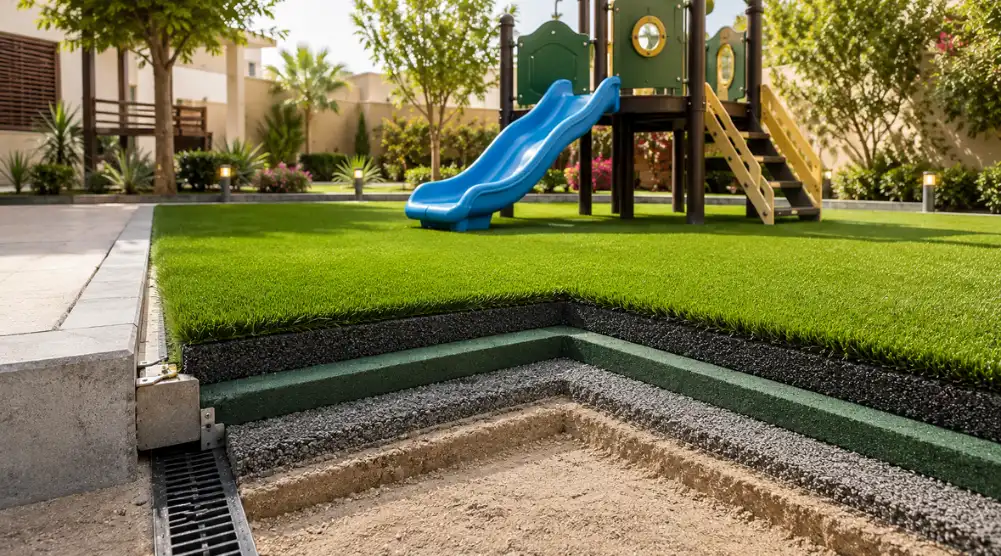
Artificial grass can suit areas where the client wants a landscaped appearance or a visual connection with nearby gardens.
Standard landscape turf alone should not be assumed to provide suitable impact attenuation.
Where protective surfacing is required, assess the complete system:
- Artificial turf
- Shock-absorbing underlay
- Seams
- Edge fixings
- Base construction
- Drainage
- Installation method
Request test information that matches the complete proposed construction and applicable equipment fall height. Do not judge the system from the shock pad alone.
Artificial turf can also reach high temperatures under direct sunlight. It should not be described as cooler than rubber without relevant product-specific evidence or measurements.
Common Purchasing and Installation Mistakes
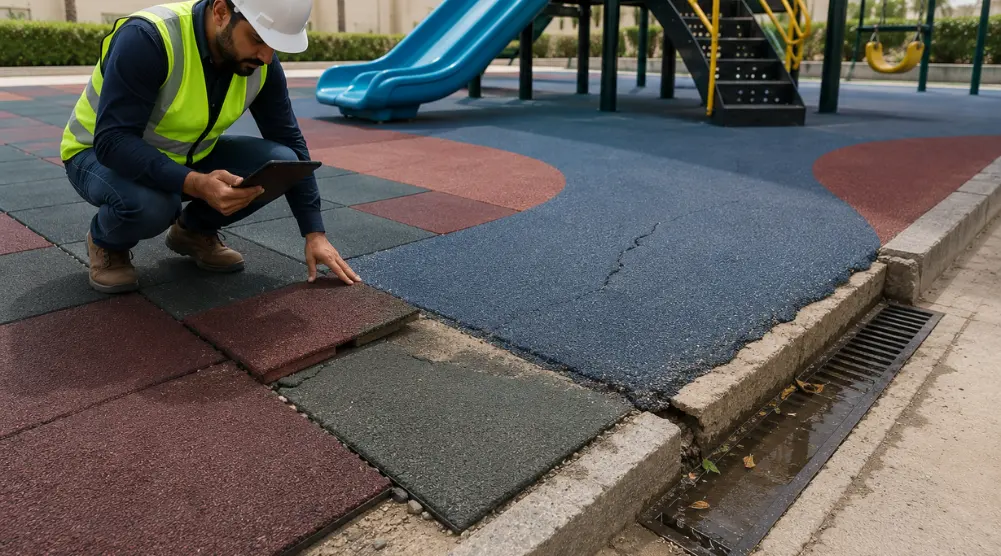
Comparing Only the Price per Square Metre
A lower rate may exclude base correction, shock layers, primers, drainage, perimeter work, curing protection, testing, or repairs.
Compare quotations line by line rather than comparing one headline figure.
Selecting Thickness Before Reviewing the Equipment
The flooring specification should follow the applicable equipment fall heights and test evidence. It should not begin with an arbitrary depth.
Accepting Unrelated Technical Documents
A report should cover the materials, depths, and construction being offered. Documentation for another system provides limited support.
Ignoring the Substrate
New rubber cannot permanently correct a moving slab, poor compaction, wrong gradients, or trapped water.
Treating Porosity as a Drainage Plan
Water passing through rubber still needs somewhere to go.
Leaving the Binder Unspecified
The binder type, proportion, mixing process, and installation limits should follow the system manufacturer’s requirements.
Avoid accepting an undefined “standard binder” without supporting product details.
Opening the Area Before Curing Is Complete
Early access can mark, move, or damage uncured material. The installation programme should state the required protection period and reopening conditions.
Underestimating Perimeter Details
Entrances, kerbs, ramps, drains, and unsupported transitions are common locations for movement or damage.
Finishing Without a Maintenance Plan
Handover should include cleaning instructions, inspection priorities, repair guidance, warranty terms, and responsibilities.
Practical Approval Checklist
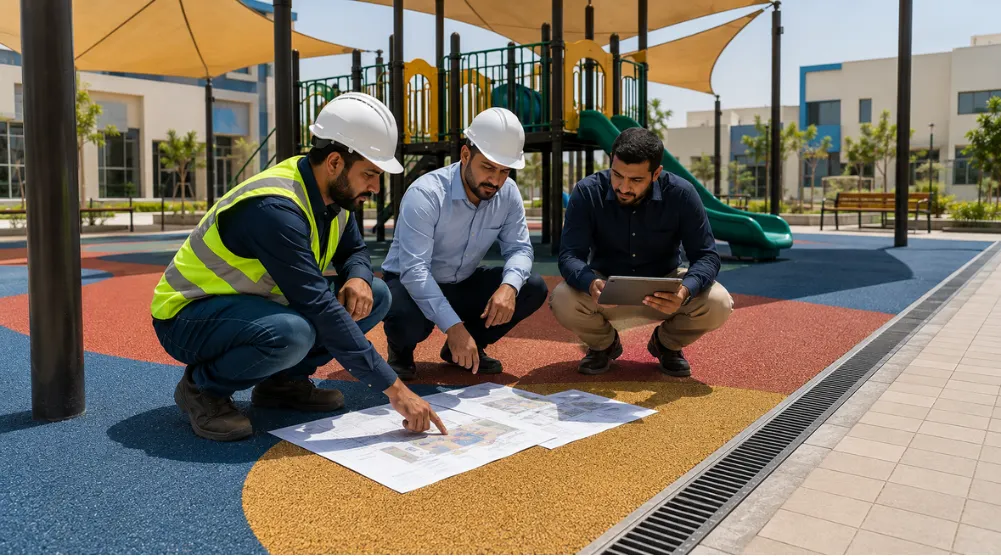
Before approving a Playground Rubber Flooring Saudi Arabia specification, confirm that:
- Equipment fall heights are identified
- Impact areas are shown
- The surface rating meets the project requirement
- Test documents cover the quoted construction
- Thickness has not been selected from a generic chart
- Laboratory and field results are correctly described
- The substrate is compatible with the system
- Base levels and gradients are confirmed
- Drainage routes are shown
- Post, edge, drain, and transition details are defined
- Colours suit the site’s sun exposure
- Shade has been reviewed at peak operating times
- Installation temperature and moisture limits are documented
- Binder, primer, and adhesive products are identified
- The curing and protection period is clear
- Coastal corrosion details are addressed where relevant
- Cleaning and repair instructions will be provided
- Warranty coverage and exclusions are written
- Field-testing responsibilities are defined where required
- The installer has relevant surfacing experience
Frequently Asked Questions
Are rubber tiles or EPDM better for playgrounds?
Neither is always better. Rubber tiles support modular replacement and suit regular layouts. Poured EPDM provides a continuous finish and greater design flexibility. Your decision should consider tested impact performance, equipment fall height, substrate condition, drainage, use, installation quality, and future repairs.
How thick should playground rubber flooring be?
There is no universal thickness. The required construction depends on the equipment fall height and the tested performance of the complete flooring system. Rubber type, density, binder, layers, installation, and site condition can all affect performance.
Does rubber flooring become hot in Saudi Arabia?
Yes. Exposed rubber can become hot under strong Saudi sunlight. Colour, composition, shade, wind, solar exposure, and time of day affect its temperature. Lighter colours and shade may help, but neither guarantees a cool surface.
Can artificial grass be used under playground equipment?
It may be suitable when installed as part of a tested system with an appropriate shock-absorbing layer. Standard landscaping turf alone should not be assumed to provide protective surfacing. Assess the complete turf, pad, seams, base, drainage, and fixing system.
How long does playground rubber flooring last?
There is no single lifespan for every surface. Service life depends on the product, installation, traffic, climate exposure, drainage, cleaning, repairs, and maintenance. Ask for product-specific maintenance guidance and written warranty conditions rather than relying on a general lifespan claim.
How should rubber playground flooring be maintained?
Remove sand, litter, leaves, and dirt regularly. Keep drains and joints clear and follow the manufacturer’s cleaning instructions. Inspect for lifting edges, open joints, cracks, loose granules, worn areas, and standing water. Investigate the cause before completing repairs.
Can damaged rubber flooring be repaired?
Many tile and poured systems can be repaired. Individual tiles may be replaceable, while poured sections can often be cut and patched. The method depends on the product and cause of damage, and the repair may remain visible.
What should a flooring quotation include?
The quotation should identify the materials, layers, depths, substrate preparation, drainage, edging, test evidence, installation scope, curing period, cleaning guidance, repair process, warranty terms, and any required field testing.
Conclusion
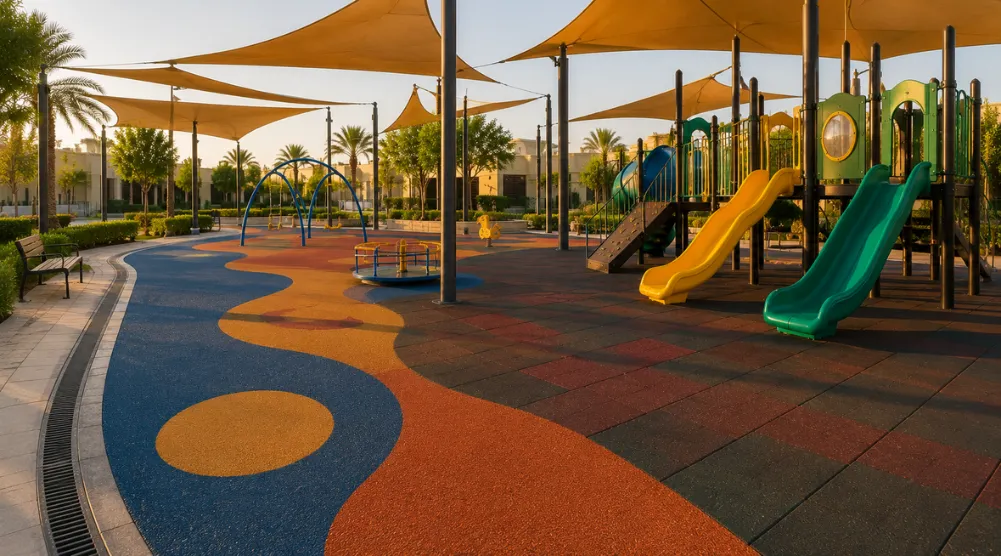
The right Playground Rubber Flooring Saudi Arabia system must do more than improve the appearance of a play area.
It should provide impact performance suited to the equipment, work with the prepared substrate, drain correctly, handle local site conditions, and remain practical to clean, inspect, and repair.
Rubber tiles offer modular replacement. Poured EPDM provides a continuous finish and flexible design. Artificial grass with an appropriately tested shock-pad system may suit selected landscaped areas.
Review the test documents, substrate, drainage, heat exposure, installation method, curing requirements, and maintenance plan before approval. Careful decisions at this stage can prevent avoidable defects after handover.
Planning a new playground surface or replacing a damaged one? You can contact Garden Links to discuss your site, equipment layout, and suitable flooring options.