.png)

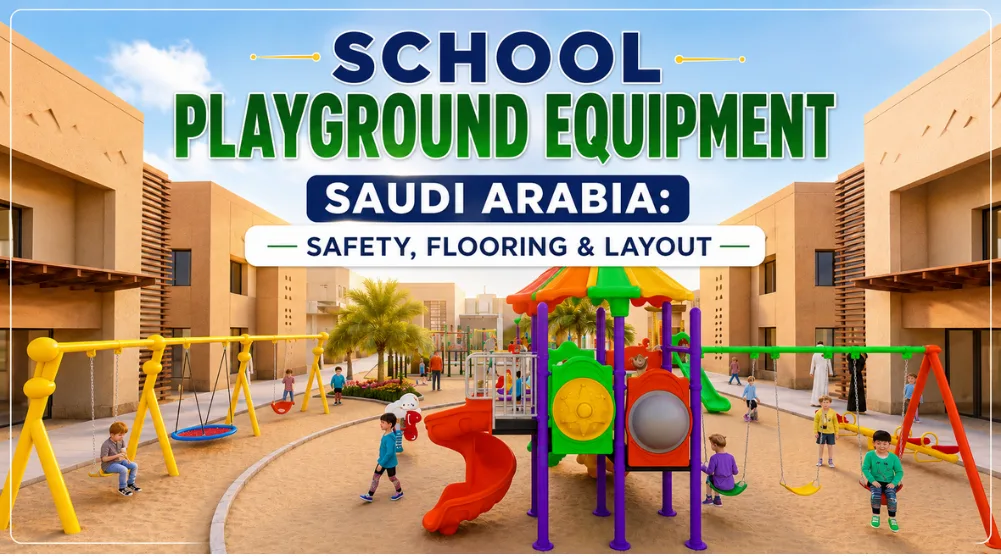

A school playground can look perfect on a drawing and still struggle during the first busy break.
One slide develops a queue. Children cut across the swing path. A quiet corner disappears from the teacher’s view. The flooring looks soft, but nobody confirmed whether it suits the equipment and fall height above it.
Choosing school playground equipment in Saudi Arabia therefore involves much more than selecting colourful play structures. Schools need to consider student age, peak user numbers, equipment capacity, safety clearances, flooring, shade, supervision and how children actually move through the site.
This guide explains what schools should check before selecting equipment, how to plan the layout, which flooring systems to consider, and how to create a playground that remains practical during real school use.
Why Good School Playgrounds Begin With Planning
The best playgrounds are planned before equipment reaches the site.
A measured layout helps identify where children will enter, gather, run, climb, queue and rest. It also shows where equipment cannot be placed safely without interfering with another activity or circulation route.
School playgrounds face a particular challenge: break periods are short but intensive. Large groups of pupils may enter the area at the same time and move quickly toward the most popular activities.
This means school playground planning needs to account for:
- Clear movement routes
- Equipment capacity
- Supervision points
- Age separation
- Safety zones
- Shade coverage
- Flooring requirements
- Maintenance access
Getting these decisions right before installation is considerably easier than relocating equipment, changing foundations or replacing unsuitable flooring later.
What Schools Should Check Before Choosing Playground Equipment
Before comparing equipment, determine how the playground will actually be used.
Start with the number of children expected during the busiest break rather than total school enrolment. A large school may release only part of its student population at one time, while a small nursery may use its entire playground simultaneously.
Schools should confirm:
- Student age groups
- Available site dimensions
- Expected peak users
- Equipment capacity
- Accessibility requirements
- Teacher observation points
- Entry and exit locations
- Surface levels and drainage
- Shade coverage
- Maintenance access
A proper site survey is important because walls, columns, drains, planting, underground services and level changes can reduce the usable play area.
Age Groups and Abilities
Nursery children generally need lower platforms, short slides, easy access steps and activities closer to ground level.
Primary-age children can usually use a wider combination of climbing, sliding, swinging and balancing activities.
Older students often benefit from greater physical challenge and more space for movement and social interaction.
Using exactly the same equipment for every age group can result in younger children feeling overwhelmed while older pupils quickly lose interest.
Peak Playground Capacity
Equipment capacity should influence the overall layout.
One large play structure may appear to use the available space efficiently, but it can become a bottleneck when many children want to use the same slides or access points.
A better school layout often distributes activity across slides, swings, climbing features, balance play and open movement areas.
How Children Actually Move
Children rarely follow the exact routes shown on a drawing.
They take shortcuts toward friends, gates, drinking points and favourite equipment.
Before approving the layout, check whether a child might:
- Cross a swing path
- Stop at the bottom of a slide
- Run through a quieter play area
- Queue across a main pathway
- Block an access point
Designing around real behaviour makes the playground easier to supervise and use.
Best Playground Equipment for Schools
The most effective school playgrounds provide different forms of movement rather than filling the site with similar activities.
Schools reviewing equipment can start with commercial outdoor playground equipment intended for regular school, nursery, park and public-space use.
Multi-Activity Play Structures
Multi-activity systems combine several play functions within one footprint.
Depending on the model, they may include:
- Slides
- Elevated platforms
- Bridges
- Climbing elements
- Tunnels
- Stairs
- Activity panels
They are particularly useful when schools need several activities within a limited area.
The equipment dimensions alone should not determine whether a structure fits. Schools must also consider user capacity, access points and the required area around the equipment.
Swings and Slides
Swings and slides are familiar activities that children understand immediately.
Their placement, however, requires careful planning.
Swing movement zones should remain clear in front of and behind the frame, while slide exits should not direct children into busy pathways, seating or nearby equipment.
Climbing Activities
Climbing equipment can support:
- Strength
- Grip
- Balance
- Coordination
- Confidence
- Problem-solving through movement
Difficulty should match the intended age group.
Check climbing height, handholds, step spacing, access routes and the surface below before choosing a structure.
Spring Riders and Seesaws
Spring riders can work particularly well in nursery and early-years areas because they provide controlled movement within a relatively compact footprint.
Seesaws introduce shared movement, balance and timing.
Both require sufficient space around the equipment for movement, access and supervision.
Open and Quiet Play Areas
Not every square metre needs fixed equipment.
Open areas give schools flexibility for running, group games and changing activities.
Quieter areas can include seating, low-level activities or sensory elements for children who want to remain within the playground without participating in higher-energy play.
How to Plan a Safe School Playground Layout
A practical school layout separates activities that move differently.
Running, swinging, climbing, sliding, waiting and resting should not all compete for the same route.
A playground can be divided into zones such as:
- Active climbing and sliding
- Swing and moving-equipment areas
- Nursery or low-level play
- Open movement space
- Quiet or sensory areas
- Shaded seating and rest zones
These divisions do not always require physical barriers. Flooring colours, pathways, equipment direction and landscaping can also help define activity areas.
Keep Main Routes Clear
Main circulation routes should connect entrances, classrooms, seating, water points and activity zones without forcing children through moving equipment.
Avoid leaving narrow passages between equipment simply because they appear usable on the plan.
Children will still attempt to pass through them during busy periods.
Protect Fall and Movement Areas
Different types of equipment require different clearances and protective areas.
These should be based on the equipment specification and applicable project requirements rather than estimated visually.
GSO EN 1176 addresses general safety requirements for permanently installed playground equipment, with additional parts covering specific equipment types.
Maintain Teacher Sightlines
Teachers should be able to see key activity areas from practical supervision points.
Check sightlines toward:
- Entrances and exits
- Swing zones
- Climbing equipment
- Slide exits
- Younger children’s areas
- Quiet corners
Tall structures, shade posts, solid panels, buildings and landscaping can interrupt visibility.
A layout that appears open from above may feel very different from ground level.
Separate Different Age Groups
When nursery and older pupils share one site, they should not be forced into the same high-traffic activity zone.
Separation can be created through:
- Equipment height
- Different activity types
- Flooring patterns
- Pathways
- Scheduled use
- Distinct access points
Younger children generally benefit from slower movement and lower challenge, while older children need greater variety and independence.
Best Flooring Options for School Playgrounds
Playground flooring should be selected together with the equipment, not after installation.
The appropriate system depends on:
- Equipment height
- Impact requirements
- Base condition
- Drainage
- Heat exposure
- Maintenance
- Intended use
A surface can appear soft without necessarily providing the required impact performance.
Schools comparing systems can review Garden Links’ playground flooring solutions.
GSO EN 1177 covers methods for evaluating the impact attenuation of playground surfacing.
Rubber Tiles
Rubber tiles provide a modular flooring system.
One practical advantage is that individual damaged tiles may be replaced without removing the entire surface.
Installation still depends on a stable, level base. Schools should monitor:
- Joints
- Edges
- Tile movement
- Drainage
- Surface condition
EPDM Poured Rubber Flooring
EPDM provides a continuous surface and offers considerable design flexibility.
Different colours can help identify:
- Age zones
- Activity areas
- Routes
- Boundaries
Its performance depends heavily on installation quality, including base preparation, layer thickness, mixing, curing, drainage and edge finishing.
Artificial Grass With Shock-Absorbing Underlay
Artificial grass provides a softer visual appearance and works well in open play, landscaped and social areas.
Under elevated playground equipment, the complete system may require a suitable shock-absorbing layer.
Artificial grass alone should not automatically be assumed to provide sufficient impact protection.
Quick Flooring Comparison
| Flooring Option | Main Strength | What to Check |
| Rubber tiles | Localised replacement | Edges, joints, thickness and base |
| EPDM flooring | Seamless finish and custom design | Installation quality and drainage |
| Artificial grass system | Natural appearance and comfort | Appropriate underlay beneath equipment |
There is no single flooring system that is best for every school playground.
The correct choice depends on the complete equipment and surfacing system.
Materials Suitable for Saudi School Playgrounds
School playground equipment in Saudi Arabia may be exposed to strong sunlight, high temperatures, dust, repeated cleaning and frequent daily use.
Coastal locations introduce additional humidity and corrosion considerations.
Schools should look beyond general claims such as “outdoor quality” and check the actual frame, coating, plastic components, fasteners and anchoring system.
Galvanized Steel
Galvanized steel is widely used for structural playground components because of its corrosion resistance.
However, joints, welds, fixing points and damaged coating areas still require periodic inspection.
Powder-Coated Metal
Powder coating adds colour and surface protection to metal components.
Surface preparation and application quality are important. Chips or scratches should be addressed before exposed areas deteriorate further.
UV-Stabilized Plastics
LLDPE and HDPE are commonly used for slides, panels, roofs and other molded playground components.
For Saudi outdoor applications, schools should consider not only the material type but also:
- UV stabilization
- Wall thickness
- Smooth finishing
- Connection quality
- Replacement availability
For a more detailed material comparison, see the playground equipment materials guide.
Fasteners and Anchoring
Bolts, chains, bearings, caps and anchors are smaller components, but they experience repeated movement and wear.
They should remain secure, protected and accessible for routine inspection.
Schools in coastal environments may need to inspect exposed metal connections more frequently.
From Site Survey to Playground Installation
Good installation begins before equipment assembly.
A typical school playground project should move through several stages.
1. Site Measurement
Confirm usable dimensions, levels, access points, drainage and fixed obstacles.
2. Equipment Positioning
Arrange activities according to age group, user capacity, circulation and supervision requirements.
3. Safety and Flooring Coordination
Confirm clearances and flooring requirements before foundations and surface finishes are completed.
4. Structural Installation
Equipment should be assembled, aligned and anchored according to the product requirements and approved site layout.
5. Final Inspection
Before handover, check structural connections, access points, guardrails, moving components, surfacing and surrounding areas.
Planning these stages together reduces the risk of costly changes during installation.
Common School Playground Planning Mistakes
Many expensive playground problems begin before installation.
Buying Equipment Before Measuring the Site
Product dimensions do not represent the entire required area.
Schools also need to account for movement, safety clearances, foundations, drainage and maintenance access.
Filling Every Available Space
More equipment does not automatically create a better playground.
Overcrowding can produce narrow routes, overlapping activities, weaker sightlines and difficult maintenance.
Open space is a functional part of the playground.
Choosing Flooring Mainly by Colour
Colour can support zoning and design, but performance must come first.
Flooring should suit the equipment, base, drainage and impact requirements.
Adding Shade Too Late
Shade structures should be considered during layout planning.
Late installation can place columns inside circulation or equipment zones and may still leave important areas exposed during school hours.
Ignoring Maintenance Access
Technicians need practical access to:
- Anchors
- Bolts
- Chains
- Moving components
- Flooring edges
- Drainage
Equipment positioned too closely together can make inspection and repair unnecessarily difficult.
Relying Only on Equipment Quality
Even good equipment can perform poorly when installed within a weak layout.
Equipment selection, installation, flooring, spacing, supervision and maintenance should work as one system.
For broader planning considerations, schools can also review the Garden Links playground safety standards guide.
School Playground Planning Checklist
Before approving school playground equipment, confirm that:
- The site has been measured accurately
- Student age groups are defined
- Peak user numbers are understood
- Equipment capacity suits expected demand
- Different activities provide different play value
- Safety and movement zones are shown
- Swing paths remain clear
- Slide exits avoid busy circulation routes
- Teachers have practical sightlines
- Flooring matches the equipment above it
- Drainage and cleaning access are planned
- Shade reaches important activity areas
- Maintenance teams can reach key components
- Future expansion remains possible
- Installation responsibilities are documented
- Inspection procedures are planned after handover
GSO EN 1176-7 provides guidance relating to playground installation, inspection, maintenance and operation.
FAQs
What is the best playground equipment for schools in Saudi Arabia?
The best equipment mix depends on student age, available space, expected user numbers and supervision requirements. Most schools benefit from combining slides, swings, climbing activities, balance equipment, open movement areas and shaded spaces rather than relying on one oversized structure.
Which flooring is best for a school playground?
The right flooring depends on the equipment, fall height, impact requirements, drainage and site conditions. Rubber tiles, EPDM and artificial grass systems may all be suitable when properly specified as part of the complete playground system.
How can schools reduce heat in outdoor playgrounds?
Shade should be planned before installation. Priority areas may include elevated platforms, slide access points, nursery zones, seating and waiting areas. Schools should also consider airflow, activity schedules and surface temperature during periods of extreme heat.
How often should school playground equipment be inspected?
Visual checks should be carried out regularly, with more detailed inspections scheduled according to equipment use, manufacturer guidance, site conditions and applicable requirements. Written inspection records help identify gradual wear before it becomes a larger maintenance issue.
Can Garden Links plan and install school playgrounds in Saudi Arabia?
Yes. Garden Links supports school and nursery playground projects with equipment selection, layout planning, flooring coordination and installation across Saudi Arabia.
Plan a School Playground That Works in Daily Use
A successful school playground is not defined by how many products fit into the space.
The equipment should suit the children using it. Flooring should match the activity above it. Teachers should have practical sightlines. Shade should cover the areas children actually use, and maintenance teams should be able to reach important components.
Schools can review completed Garden Links playground projects to see how different equipment and layouts have been used in real sites.
Planning a new school playground or upgrading an existing one? Contact Garden Links to discuss your site dimensions, student age groups, equipment, flooring and layout requirements.