.png)

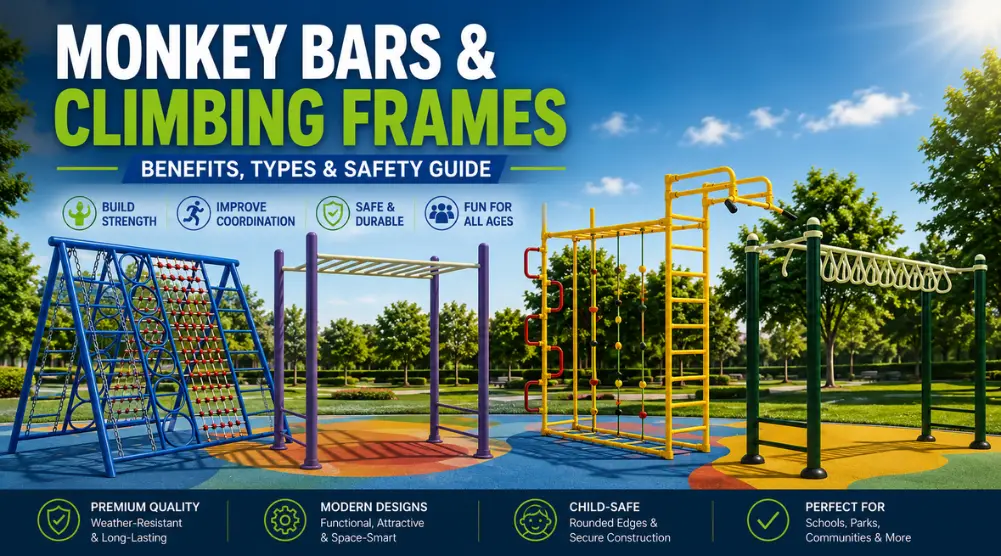

A monkey bars playground gives children more than just something to climb. It encourages hanging, swinging, reaching and controlled movement while helping develop strength, coordination, balance and confidence through active outdoor play.
Monkey bars are commonly used in schools, public parks, residential compounds, recreation areas and private gardens. They can be installed as simple freestanding equipment or included as part of larger climbing frames with ladders, platforms, ropes, bridges and other climbing activities.
The right design depends on several factors, including the children’s age group, available space, equipment difficulty, materials, safety surfacing and how frequently the playground will be used.
This guide explains the main benefits and types of monkey bars, how they differ from climbing frames, what to consider before choosing one, and the basic safety points that matter for playground projects in Saudi Arabia.
What Are Monkey Bars?
Monkey bars are playground climbing equipment made up of overhead bars that children move across using their hands.
Depending on the design, children may:
- Hang from individual bars
- Swing from one bar to the next
- Traverse horizontally
- Climb across curved or spiral layouts
- Combine the bars with ladders or other climbing elements
A simple monkey bar set can work as an independent playground activity, while larger climbing systems may integrate monkey bars into a complete multi-activity structure.
Benefits of a Monkey Bars Playground
Monkey bars remain popular because one relatively simple activity can challenge several movement skills at the same time.
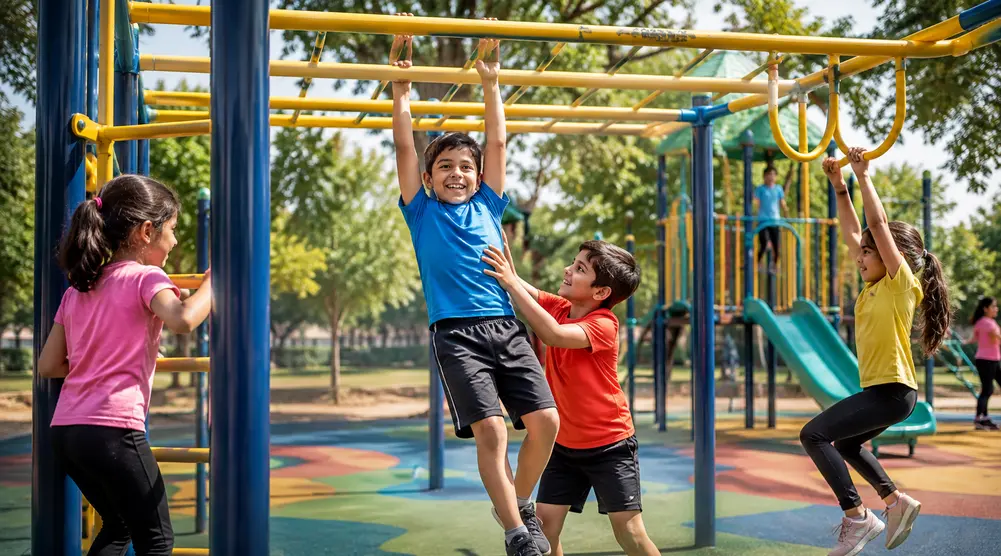
Builds Upper-Body Strength
Moving across overhead bars requires children to support and control their own body weight.
This activity engages areas such as the:
- Hands and forearms
- Arms
- Shoulders
- Back
- Core
The difficulty depends on the height, bar spacing, layout and individual child’s ability.
Develops Grip Strength
Children repeatedly grip, release and reach for the next bar while crossing the equipment.
This naturally challenges hand and forearm strength and teaches children how to maintain control while moving.
Supports Coordination and Body Control
Successfully crossing monkey bars requires children to coordinate their hands, upper body and lower body while judging the position of the next bar.
This can support:
- Gross motor development
- Hand-eye coordination
- Balance
- Spatial awareness
- Controlled body movement
Builds Confidence Through Challenge
Monkey bars give children a clear challenge with visible progress.
A child may initially manage only one or two bars before gradually crossing a longer section. This type of progression can encourage confidence and persistence without requiring a competitive activity.
Encourages Active Outdoor Play
Monkey bars provide a physical activity children can return to repeatedly.
When combined with slides, swings and climbing elements, they help create a playground with different ways to move rather than relying on one activity.
Supports Social Play
Monkey bars can also create natural opportunities for children to interact.
They may:
- Take turns
- Watch how other children cross
- Encourage friends
- Create their own challenges
- Move between activities together
Different Types of Monkey Bars
There is no single monkey bar design that suits every playground.
The best type depends on the available area, intended users and required level of challenge.
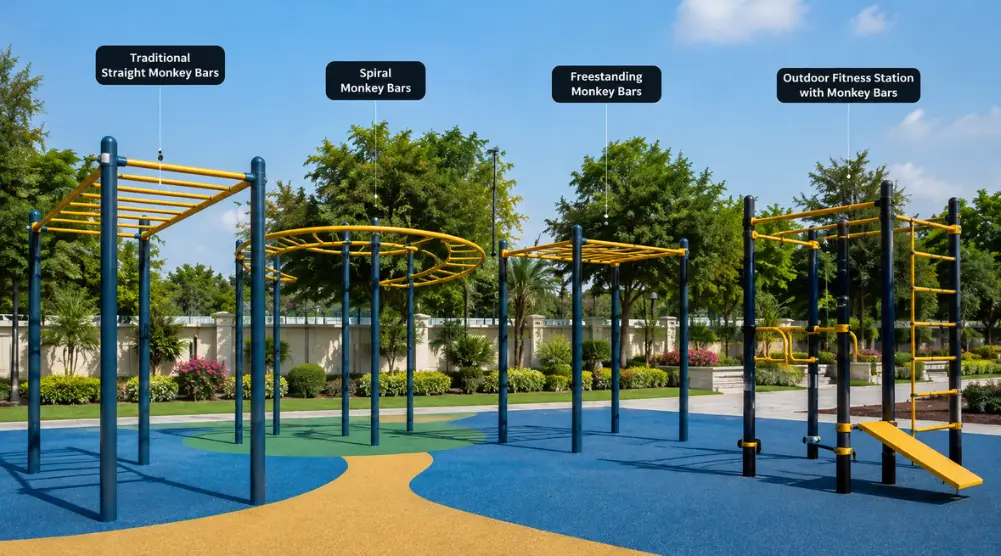
Traditional Monkey Bars
Traditional monkey bars usually use a straight row of overhead horizontal bars.
They are commonly used in:
- Schools
- Public parks
- Residential compounds
- Community playgrounds
Their simple layout makes them easy to understand and integrate into many playground designs.
Spiral Monkey Bars
Spiral or curved monkey bars change the direction of movement rather than following a completely straight line.
They generally create a more challenging experience because children must adjust their reach and body position as they move.
They can be useful in:
- Adventure-style play areas
- Larger playgrounds
- Playgrounds serving more capable climbers
Freestanding Monkey Bars
Freestanding monkey bars are independent structures that do not need to be connected to a larger play tower.
They can be useful where:
- Space is limited
- A separate climbing zone is needed
- An existing playground is being upgraded
- The project needs individual activity stations
Monkey Bars Integrated Into Climbing Frames
Many modern climbing frames combine monkey bars with:
- Climbing walls
- Vertical ladders
- Rope climbing elements
- Platforms
- Bridges
- Slides
- Activity panels
This creates a more varied movement experience within one play structure.
Outdoor Fitness Stations With Monkey Bars
Some equipment combines overhead bars with fitness activities suitable for older users.
An outdoor fitness station with monkey bars may support activities such as:
- Pull-ups
- Hanging exercises
- Traversing
- Grip training
These designs should be selected according to the intended user group rather than treated as children’s playground equipment by default.
Monkey Bars vs Climbing Frames
Monkey bars and climbing frames are related, but they are not exactly the same.
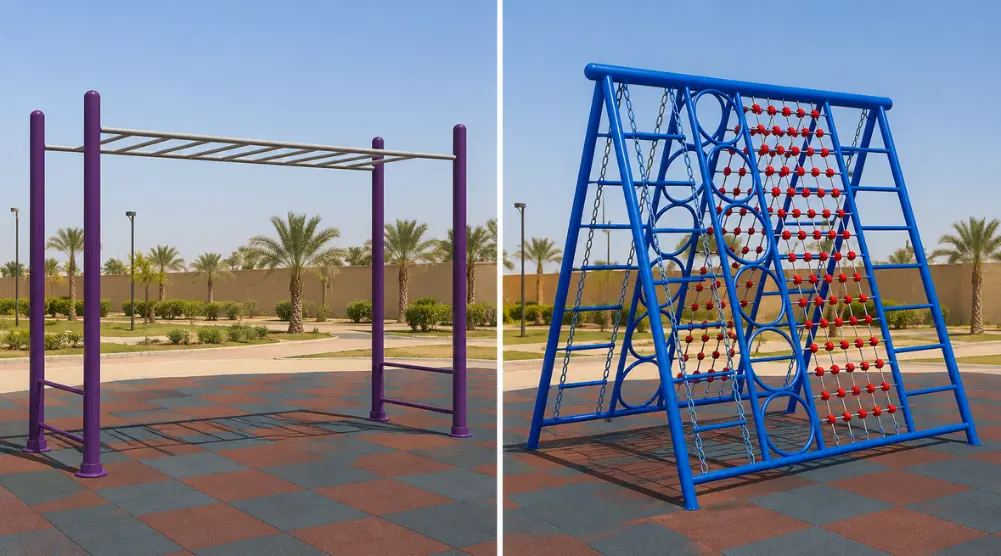
| Feature | Monkey Bars | Climbing Frames |
| Main activity | Hanging and traversing | Multiple climbing activities |
| Layout | Usually compact | Can be larger and multi-level |
| Activities | Primarily overhead bars | Bars, ladders, ropes, walls, bridges and more |
| Space requirement | Often lower | Depends on structure size |
| Best use | Standalone challenge or activity zone | Complete climbing experience |
| Complexity | Simple to advanced | Usually more varied |
A project does not necessarily have to choose one or the other. Monkey bars can form part of a larger climbing frame or be installed independently.
Which Monkey Bars Are Suitable for Different Age Groups?
Age suitability should be determined from the specific product design, manufacturer recommendation, equipment height, spacing and level of difficulty.
It is better not to select monkey bars based only on a general age number.
For younger users, projects usually require:
- Lower equipment
- Easier access
- Shorter movement challenges
- Age-appropriate handholds
- Suitable surrounding surfacing
Older or more capable users may be comfortable with:
- Longer traverses
- Higher difficulty
- Curved or spiral layouts
- More complex climbing combinations
For schools, nurseries and public playgrounds, the intended age group should therefore be confirmed before selecting the equipment.
How to Choose the Right Monkey Bars
Before purchasing or specifying monkey bars, consider the following factors.
1. Available Space
Measure the site before selecting the product.
The equipment footprint is only one part of the planning process. Space is also needed around the structure according to the equipment design and applicable safety requirements.
For smaller locations, a freestanding unit may be more practical than a large multi-activity frame.
2. Intended Users
Ask:
- What age group will use the playground?
- Is the equipment for a school, park or residential project?
- Will several children use it throughout the day?
- Is the activity intended for beginners or more confident climbers?
These questions help determine the appropriate level of difficulty.
3. Equipment Layout
Monkey bars should fit naturally into the playground rather than being added without considering how children move between activities.
For example, they can be positioned alongside:
- Climbing elements
- Slides
- Swings
- Balance activities
- Open movement zones
A balanced layout can help distribute children across the playground.
4. Materials and Construction
Outdoor playground equipment in Saudi Arabia is exposed to strong sunlight, heat, dust and regular use.
Depending on the product specification, common construction materials can include:
- Galvanized steel
- Powder-coated steel
- Outdoor-grade plastic components
- Weather-resistant fasteners and fittings
Material quality should be evaluated as part of the complete product specification rather than by appearance alone.
For a deeper comparison, see our guide to playground equipment materials for Saudi Arabia.
5. Safety Surfacing
Because monkey bars involve climbing and potential falls, the surface beneath and around the equipment is an important part of the playground design.
Depending on the project and equipment requirements, suitable impact-attenuating surfacing may include:
- Rubber safety tiles
- Poured-in-place rubber
- Engineered wood fibre
- Other appropriate playground surfacing systems
The required surfacing should be selected according to the equipment and applicable safety requirements rather than choosing flooring only by appearance.
Important Monkey Bar Safety Considerations
Children should be able to enjoy challenging play without unnecessary hazards.
Key considerations include:
Correct Installation
The structure should be correctly positioned, assembled, aligned and fixed according to the equipment and site requirements.
Appropriate Fall Area
Adequate surrounding space should be maintained around the equipment.
The required area depends on the design, height and applicable playground requirements.
Suitable Safety Flooring
Surfacing beneath climbing equipment should be suitable for the potential fall conditions of the equipment.
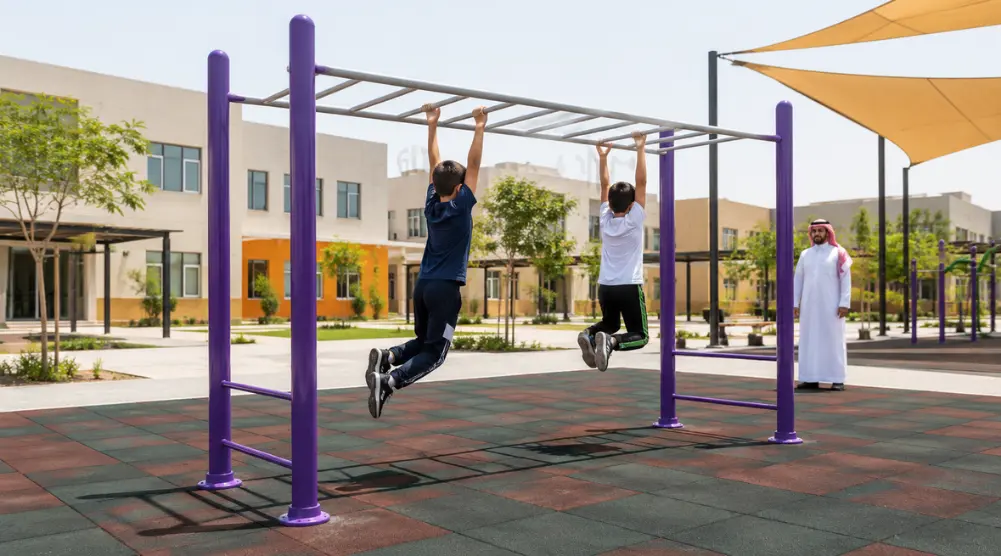
Secure Connections
Bolts, bars, joints and structural connections should remain secure and should not create accessible sharp or hazardous points.
Routine Inspection
Outdoor equipment should be periodically checked for issues such as:
- Loose connections
- Damaged coatings
- Corrosion
- Worn components
- Structural movement
- Damaged flooring
User Supervision
Younger children may require supervision depending on the environment, their ability and the equipment design.
For broader project requirements, read our Playground Safety Standards in Saudi Arabia guide.
Choosing Monkey Bars for Saudi Arabia
Saudi playground projects require additional attention to outdoor conditions.
When selecting monkey bars for long-term exterior use, consider:
- Exposure to strong sunlight
- High summer temperatures
- Dust and outdoor weather conditions
- Corrosion protection
- Quality of coatings
- Ground fixing
- Safety surfacing
- Inspection and maintenance access
The appropriate specification will vary by site, so equipment intended for a shaded school playground may have different planning requirements from equipment installed in a large public park.
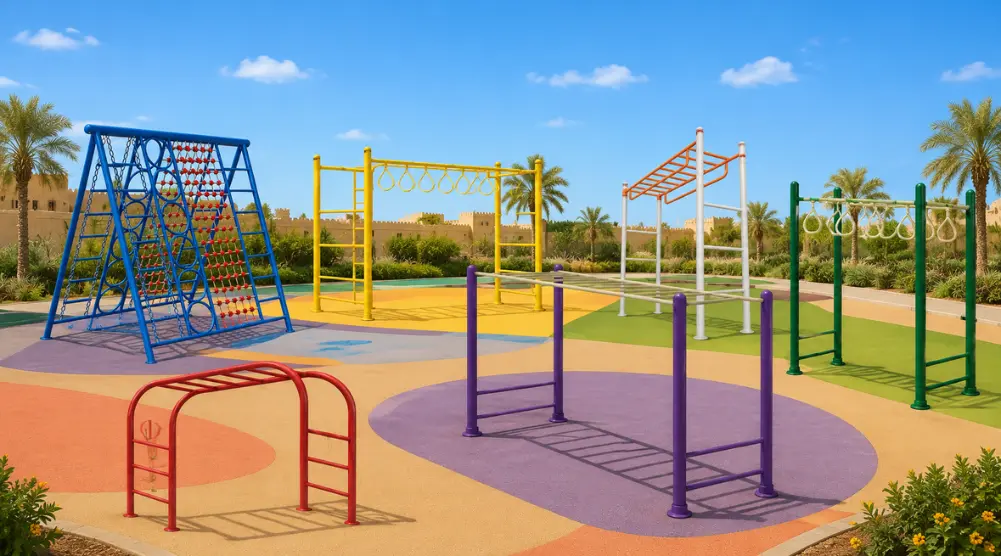
Monkey Bars for Schools
School playgrounds often experience regular daily use, so equipment selection should consider:
- Student age groups
- User capacity
- Durability
- Supervision
- Playground layout
- Maintenance
- Safety surfacing
Monkey bars can work well as part of a larger activity area containing different climbing, balancing and movement challenges.
Monkey Bars for Public Parks
Public parks may serve children of different ages and abilities throughout the day.
For these environments, projects should consider:
- Heavy and repeated use
- Clear activity zones
- Equipment visibility
- Durable outdoor materials
- Suitable ground anchoring
- Inspection access
- Integration with other playground equipment
A combination of monkey bars and other outdoor playground equipment can create a more complete recreation area.
Monkey Bars for Residential Compounds and Villas
Residential play areas usually have more limited space than public parks.
A compact monkey bar or climbing structure can be useful where the project wants to add:
- Physical activity
- Climbing play
- Independent challenges
- Variety beyond slides and swings
For private spaces, the selected design should still suit the children’s age group and available installation area.
Traditional vs Spiral Monkey Bars: Which Should You Choose?
Neither design is automatically better.
Choose based on the intended users and required challenge.
Traditional monkey bars are usually the simpler option and work well in many general playground layouts.
Spiral monkey bars introduce directional changes and may provide a more challenging movement pattern.
For mixed playgrounds, designers can also combine different climbing activities rather than relying on one type.
How Much Space Do Monkey Bars Need?
There is no single space requirement that applies to every monkey bar.
The total required area depends on:
- Equipment dimensions
- Height
- Movement pattern
- Access points
- Surrounding clearance
- Safety surfacing
- Applicable product requirements
Always review the full installation layout rather than using only the equipment dimensions when planning the site.
What Should You Check Before Buying?
Before placing an order, confirm:
- Product dimensions
- Intended age range
- Material specification
- Installation requirements
- Available site dimensions
- Safety surfacing
- Ground conditions
- Warranty terms
- Delivery location
- Installation support
For projects where budget planning is also important, our Outdoor Playground Equipment Cost in Saudi Arabia guide explains the main factors that can affect equipment, installation and site costs.
What Information Should You Send for a Quotation?
Providing complete site information helps the supplier recommend a more suitable solution.
For a monkey bars or climbing equipment quotation, prepare:
- Project city
- Type of project
- Available area or dimensions
- Intended age group
- Required quantity
- Site photographs
- Drawings, if available
- Installation requirements
- Preferred equipment type
This is especially useful for school, park, compound and commercial playground projects where the equipment needs to fit into an existing layout.
FAQs
What is a monkey bars playground?
A monkey bars playground is a play area containing overhead bars that children use for hanging, swinging and traversing. Monkey bars may be installed independently or integrated into a larger climbing structure.
What are the benefits of monkey bars?
Monkey bars can encourage upper-body movement, grip strength, coordination, balance, body control, confidence and active outdoor play.
What age is suitable for monkey bars?
There is no single age that applies to every product. Suitability depends on the specific equipment design, height, difficulty and manufacturer’s recommended age range.
What is the difference between monkey bars and climbing frames?
Monkey bars primarily focus on overhead hanging and traversing. Climbing frames can combine several activities such as ladders, ropes, climbing walls, bridges, platforms and monkey bars within one structure.
Are spiral monkey bars harder than traditional monkey bars?
They can be. Curved or spiral layouts usually require children to adjust their movement direction and body position, which may make them more challenging than a simple straight set.
What flooring should be installed below monkey bars?
Suitable playground safety surfacing should be selected according to the equipment design, fall conditions and applicable requirements. Rubber tiles and poured rubber are among the options commonly used in playground projects.
Can monkey bars be installed in schools and public parks?
Yes. Monkey bars are commonly used in schools, parks, compounds and recreational spaces when the selected equipment is appropriate for the users, site and installation requirements.
Does Garden Links supply and install monkey bars in Saudi Arabia?
Garden Links supplies playground and climbing equipment for projects across Saudi Arabia, with installation support available according to the project location and requirements.
Conclusion
A well-planned monkey bars playground can add a valuable climbing and movement activity to schools, parks, compounds and residential play areas.
The best result comes from choosing equipment according to the intended users, available space, difficulty level, materials, safety surfacing and installation requirements rather than selecting a product based only on appearance.
If you are planning a monkey bar or climbing equipment project in Saudi Arabia, contact Garden Links with your project city, available area, age group and site details. The team can help you identify suitable equipment and prepare a quotation based on your project requirements.